The secret to my non-traditional carbonara is anchovies and mascarpone.
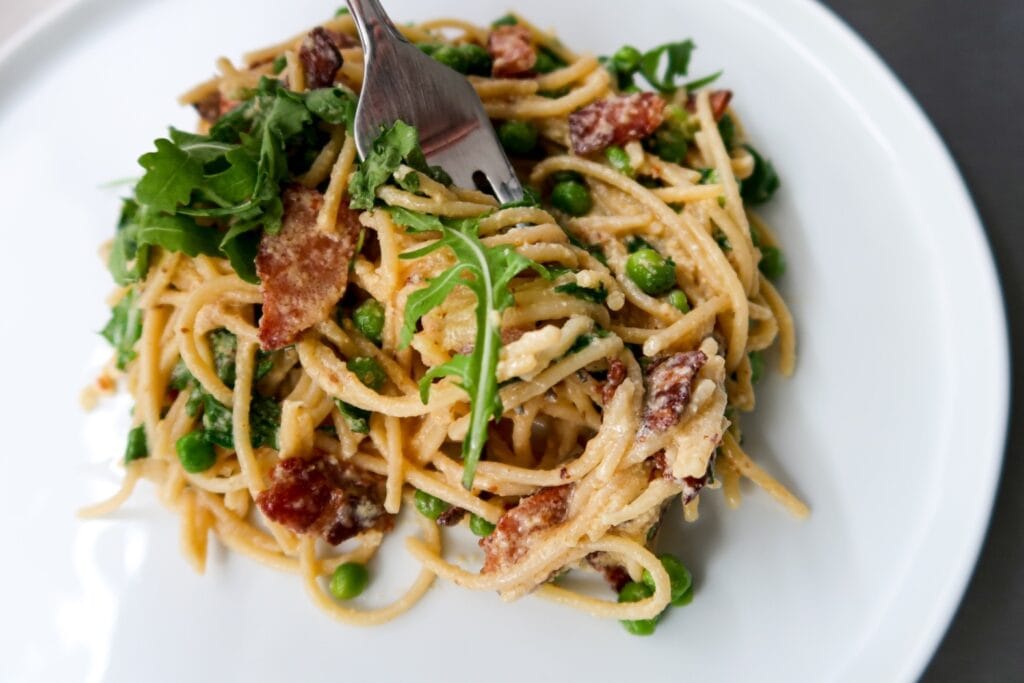
To give this rich dish a healthy twist (and some colour), I’ve sprinkled some arugula and peas.
This meal comes together in less than 30 minutes, making it the perfect meal to make during your busy work week.
Cook this for your next Friday night in and pair it with a bottle of crisp and fruity wine, like Pinot Noir or Chianti Classico.
what is carbonara pasta?
The name “carbonara” is derived from “carbonaro”, the Italian word for “charcoal burner”. This has led many to believe this hearty dish was first made for Italian charcoal workers.
This dish is not only easy to prepare but relatively economical too.
First, raw eggs and grated pecorino is whisked with freshly cracked black pepper. Then, diced guanciale, an Italian cured meat prepared from pork cheek, is fried in its own fat.
Finally, the cheesy egg mixture is swiftly tossed with steaming hot pasta. Splashes of pasta water and bacon grease are emulsified to create a rich creamy sauce.
However, modern versions have added cream, garlic and even green peas, mushrooms or broccoli to the mix.
As guanciale may be hard to come by, you can replace it with pancetta, ham or streaky bacon.
about my recipe
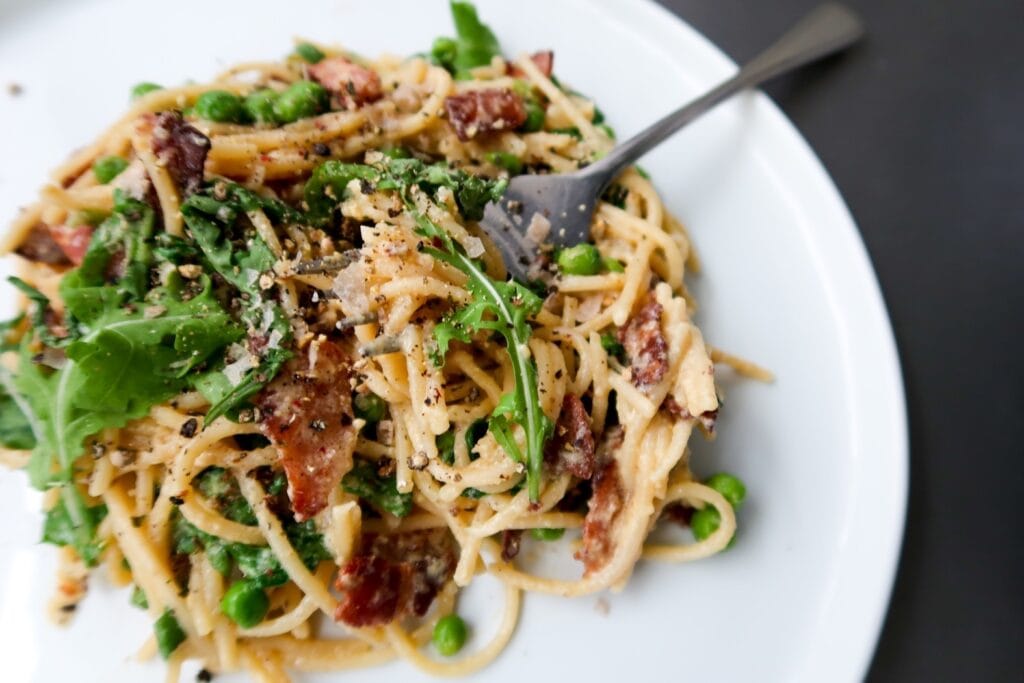
Far from the traditional way of making carbonara, my version is still delightful and easy to make.
While traditional carbonara can be made without much fuss, there is a danger of curdling the egg if the pasta is too hot.
Some carbonara recipes recommend tempering the egg mixture with some pasta water. My cheat method uses mascarpone and grated cheese to cool down the freshly cooked pasta.
Whatever it is, both methods involve deftly tossing the spaghetti high enough to cool things down while combining the egg mixture.
The difference between bacon and guanciale are many. Guanciale is made from cured pork jowl while bacon is made from pork belly.
It is also more robustly flavoured. To compensate, I add anchovies to give this dish more oomph and saltiness.
Pancetta is the next best thing. It is naturally more salty than bacon which is smoked not cured
nutrition first!
Purists, please don’t scoff at the addition of peas and arugula! The beauty of cooking food yourself is that you are able to add healthier ingredients to boost the nutritional value of the meal.
If you are serving some greens on the side or a salad as a starter, you can opt to exclude the vegetables.
Carbonara, one of Rome’s four classic pastas, can be modified however you like or scaled down to stay true to tradition.
Your food, your rules!
about the ingredients
Garlic
If you associate garlic with Italian food it’s thanks to American Italian cuisine which is notoriously loaded with this pungent herb.
Garlic is not used in the classic carbonara recipe and hardly ever in northern Italy. It is more commonly used in southern Italy, especially in stews and sauces.
Apparently, this bulbous ingredient is associated with peasant food as it is cheap and can also be used as a preservative.
As refined Italian cooking focuses more on the use of fresh produce and delicately flavoured herbs, traditional Italian chefs may frown upon the humble garlic.
Well I love garlic and do not shy away from using it in practically everything I cook. Aside from its tantalizing aromatics, it has many health benefits.
It has antibiotic properties, can help reduce high blood pressure and cholesterol levels and even boost your body’s immune system.
I say, use as much of it as your heart desires. I personally judge any recipe that calls for only one or two cloves of garlic. It has to be five or more in my opinion!
Cheese
Pecorino
Carbonara is traditionally made with pecorino. Unlike parmigiano-reggiano, which is made from cow’s milk, pecorino is made from sheep.
Both are salty and lend it’s umaminess to any dish it is used in. However, parmigiano-reggiano has a nuttier and milder profile while pecorino romano is saltier and tangy.
Parmigiano-Reggiano
Parmiagiano-reggiano is a good substitute. Dubbed by Italians as the “King of Cheeses”, it is aged longer than ordinary cheeses and can be kept for a long time in the fridge.
Save the rind to flavor soups or sauces. Grate it over pastas, shave it onto salads or simply eat it on its own. It is certainly far superior to any other cheese for its texture, taste and many uses.
However, when this sharply flavored cheese arrived on the shores of America, its mouthful of a name was shortened to “parmesan”. Thus began the confusion surrounding this cheese.
While we may call it “parmesan”, because it’s easier to pronounce, don’t be fooled into thinking that cheese labeled parmesan is the real deal.
The Italians take their cheeses seriously. For a cheese to be called parmigiano-reggiano it would have to pass certain laws governing the production of cheese.
So, please for the love of all cheese gods, read the label and only buy parmigiano-reggiano.
Mascarpone
Mascarpone is a triple-creme cheese made from fresh cream. It has a rich, velvety texture that makes it more like thickened cream than cream cheese.
As home cooks, using up whatever is in the fridge and avoiding waste are of utmost importance. If you don’t have mascarpone, you can substitute with cream or even cream cheese.
Mascarpone is used in this recipe only to help cool the spaghetti to prevent the egg from curdling.
Raw Eggs
Raw eggs can contain salmonella and while the risk is low, it is best to use pasteurized eggs.
Pasteurized eggs are heated up to a temperature of 60ºC/140ºF and held at this temperature for 3.5 minutes. This temperature is high enough to kill any bacteria without cooking the egg itself.
Pregnant women, adults older than 65, young children and people with compromised immune systems should avoid eating raw or undercooked eggs.
If you are unable to find pasteurized eggs at the store, here is how you can do it at home.
Bacon
Bacon is a cheaper alternative to pancetta and more accessible. Just be sure to buy nitrate-free bacon. Not only does it taste and look more like pork should, it is much better for you too.
I have to admit, I haven’t tried cooking carbonara with the traditional guanciale. If you’re willing to give it a go, you can track it down at specialist stores or gourmet grocers.
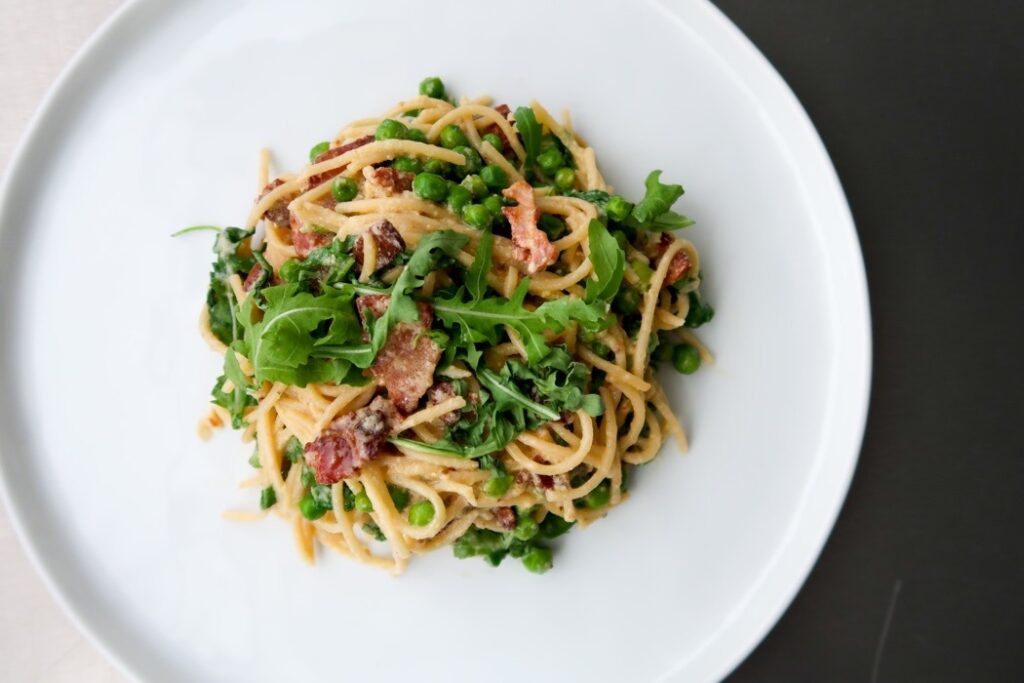
Now that you know a little bit more about my modified version of the classic carbonara…
let’s get cookin’, good lookin’!
Print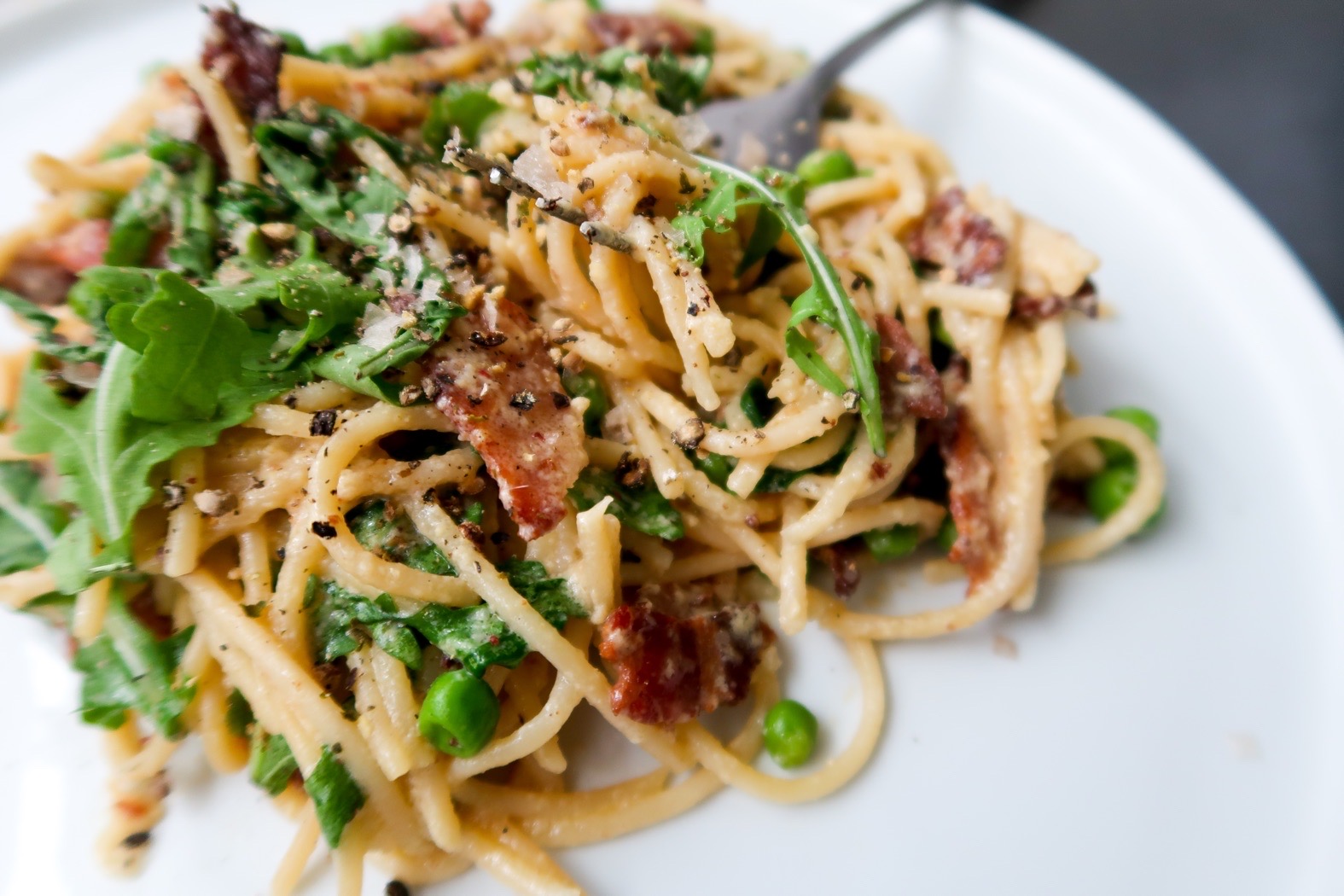
Carbonara Pasta with Bacon & Peas
- Total Time: 25 minutes
- Yield: 4 1x
Description
This is a modern version of carbonara pasta that uses mascarpone, anchovies and bacon. Topped with arugula and peas for extra nutrition, this meal comes together easily in under 30 minutes.
Ingredients
- 500g / 1.1lbs spaghetti
- 400g / 14.1oz of middle bacon, chopped into bite-size pieces
- 1 cup frozen peas
- 1 1/2 cups pecorino, grated
- 2 tablespoons mascarpone
- 3 slices of canned anchovies, shredded
- 3 pasteurised eggs, beaten
- 5 cloves garlic, 3 pressed and 2 sliced
- freshly cracked black pepper, to taste
- sea salt flakes, to taste
- arugula, for topping
Instructions
- First, prep the ingredients. Chop up the bacon, mince and slice the garlic, grate the cheese and set out the rest of the ingredients.
- Pour boiling water over the frozen peas with. Once defrosted, strain the peas and set aside.
- Beat the eggs.
- Cook the pasta in salted water until al dente. About 7 minutes. Reserve about 2 cups of pasta water.
- Meanwhile, in a large chef pan (or a pot), dry fry the bacon until crispy then set aside.
- Next, sauté the garlic in the bacon fat. Once golden, turn the fire off and return the bacon to the pan/pot.
- Quickly transfer the hot pasta into the pan with the bacon fat, allowing any pasta water to drip in.
- Chuck in the peas, anchovies and about ¾ of the cheese.
- Add in the mascarpone.
- Tip in the beaten egg and with tongs, lift the pasta up high to combine everything.
- Stir in half a ladle of pasta water, or more if necessary, to create more sauce. You don’t want it too watery or too thick either.
- Top with the remaining grated cheese and serve with some arugula and sea salt flakes to taste if you need more flavor.
- Retain some of the pasta water. You’ll need it to reheat any leftovers.
Notes
To level up, use pancetta or else the original cured meat of choice known as Guanciale.
Be sure to use pasteurized eggs!
- Prep Time: 10 minutes
- Cook Time: 15 minutes